Best Tire Inflators to Keep in Your Car or Garage
The best tire inflator depends on your tire size, power access and workload. Choose the ETENWOLF Vortex S6 for cordless higher-airflow use, the DeWalt DCC020IB for three power options, the VIAIR 300P for larger truck tires, or the Airmoto for compact top-offs.
On this page (9 sections)
- Which tire inflator is best for your needs?
- How we chose these tire inflators
- What features matter in a tire inflator?
- Which tire inflator fits a car or garage?
- How should you compare tire inflators?
- How do you set up and use a tire inflator?
- How can you care for a portable tire inflator?
- What common tire inflator mistakes should you avoid?
- Which tire inflator should you choose?
The best tire inflator depends on your tire size, power access and how much air you expect to add. A compact cordless pump is convenient for routine car top-offs, while a higher-flow 12V compressor may suit larger truck and SUV tires.
For flexible power at home or on the road, consider the DeWalt 20V MAX Inflator DCC020IB, which can run from a 20V battery, 12V DC or 110V AC source. The ETENWOLF Vortex S6 suits drivers who want a cordless model with higher stated airflow and a built-in battery.
The right pick also depends on how often you inflate tires. A driver who corrects pressure once in a while has different needs from someone airing up larger tires after off-road driving or using an inflator for more than one vehicle.
Which tire inflator is best for your needs?
Choose by matching the power source and intended workload to your vehicle. These four options cover compact top-offs, flexible power, larger tires and cordless use.
For the best tire inflator for a glove box, prioritize size and readiness. For a garage or larger vehicle, look more closely at airflow, cooling, power access and any duty-cycle limit.
How we chose these tire inflators
We compared the power sources, airflow, pressure limits and stated use guidance against common tire-inflation needs. The shortlist includes different styles for passenger cars, trucks and off-road vehicles.
A high PSI limit does not tell you how quickly a unit can fill a tire. Airflow, tire volume, starting pressure and the time a compressor can run before resting all affect the job.
Start with the pressure recommended by your vehicle maker, usually printed on the placard inside the driver’s door or in the owner’s manual. The number on a tire’s sidewall is a maximum limit, not the normal target for your vehicle.
What features matter in a tire inflator?
A useful tire inflator has a power source you can access, a pressure gauge you can read and a way to stop at your target PSI. Those features make it easier to inflate accurately and avoid repeated guesswork.
Does the power source fit how you’ll use it?
A cordless inflator is convenient when you need to reach all four tires without an extension cord. Its battery capacity and charging routine matter if you keep it in a car for emergencies.
A 12V compressor with battery clamps can suit larger tires, but you need safe access to the vehicle battery. A multi-source model gives you options at home and on the road, though batteries or adapters may be separate purchases.
If you want to compare other vehicle-powered options, see our guide to 12V air compressors for car and truck tires.
How much airflow do you need?
Airflow indicates how quickly a compressor can move air, but it is only part of the picture. A large tire or a low starting pressure takes more air than a small top-off.
A compact pump can be convenient for routine pressure corrections without being intended for repeated heavy-load work. For an SUV-focused shortlist, see our guide to tire inflators for SUVs and crossovers.
Is automatic shutoff useful?
Automatic shutoff lets you enter a target pressure and have the inflator stop when it reaches that setting. It reduces the need to watch the gauge continuously, though you should still check the final pressure if the reading seems unusual.
A digital gauge can be easier to read in dim conditions than a small dial. An LED light can also help you connect the hose at night.
What do duty cycle and cooling mean?
Duty cycle describes how long a compressor can run in a given operating period before it needs to rest. This matters most when you plan to inflate several tires in a row or work with larger tires.
The VIAIR 300P has a stated 33% duty cycle, so it needs breaks during use. The ETENWOLF Vortex S6 states a 100% duty cycle and includes a cooling system, which makes it a better fit for buyers expecting longer inflation sessions.
Which tire inflator fits a car or garage?
Choose the inflator you can power reliably and use within its intended workload. Passenger-car top-offs favor easy storage and simple controls, while larger tires make airflow, run time and power access more important.
ETENWOLF Vortex S6: cordless power for larger tires
The ETENWOLF Vortex S6 is a cordless choice for drivers who want to handle more than standard car tires. It has 1.5 CFM airflow, a 160 PSI maximum and a built-in 19,200 mAh battery.
Its automatic stop, seven preset modes and pressure memory can simplify repeat top-offs. ETENWOLF says it can fill a 31 in tire from 30 to 35 PSI in 1 minute and inflate 18 F-150 tires from 30 to 35 PSI on a full charge.
The unit also has a 1,000-lumen LED light with flashing and SOS modes, along with a USB-C 45W port for charging or powering devices. Its 100% duty-cycle claim and cooling system make it a strong match for drivers who expect to inflate multiple tires in a session.
Choose it if you want cordless operation, a built-in battery and stated capacity for larger tires. Skip it if you only need the smallest glove-box pump or want to inflate stand-up paddleboards, which ETENWOLF says it is not designed to handle.
For more model-specific details, see our ETENWOLF Vortex S6 review.
DeWalt 20V MAX Inflator DCC020IB: flexible power at home or away
The DeWalt DCC020IB offers three power options: a 20V MAX battery, 12V DC or 110V AC. The 12V DC power cord is included, while the battery, charger and AC power adapter are sold separately.
For tire inflation, the high-pressure mode has automatic shutoff and a threaded chuck. The inflator also has onboard accessory storage, an LED light and rubber feet intended to reduce movement while it runs.
A separate high-volume hose can inflate or deflate larger items such as mattresses. The 80 PSI maximum makes it important to compare the pressure limit with your tires and any other intended uses.
Choose it if you already have compatible DeWalt batteries or want several ways to power an inflator. Skip it if you need a self-contained cordless pump, since the battery and charger are sold separately.
Our ETENWOLF vs DeWalt tire inflator comparison explains the differences in power and stated capacity.
VIAIR 300P: a 12V compressor for truck and SUV tires
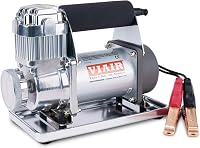
The VIAIR 300P is a 12V compressor kit for trucks, SUVs, Jeeps and off-road vehicles with tires up to 33 in. It connects with battery clamps, and the engine needs to run during use.
The kit includes a 25 ft air hose, an inline inflator and deflator gauge, a carry bag and an 8 ft power cord. Its 2.30 CFM free-flow capacity and 150 PSI maximum working pressure make it a better fit for larger tires than a compact glove-box pump.
The 33% duty cycle means the compressor needs to rest during longer sessions. Follow its operating instructions and check the pressure after switching it off.
Choose it if you need a portable 12V compressor for larger tires and are comfortable connecting clamps to the battery. Skip it if you want an independent cordless unit or need to inflate several tires continuously.
For a step-by-step method, see our guide to filling tires with an air compressor.
Airmoto Tire Inflator: compact top-offs and glove-box storage
The Airmoto is a small cordless option for car, motorcycle and bicycle tires, with a 120 PSI maximum. It measures 6.1 x 2.4 x 1.59 in and weighs 1.2 lb.
You can choose PSI, kPa, BAR or kg/cm², set a target pressure and let the unit shut off automatically. It also has a digital gauge, an LED light, a deflate button and a hose that stores inside the body.
Airmoto says its 2,000 mAh battery can top up four standard car tires from 28 to 35 PSI on a full charge. Tire size, temperature and battery charge affect that result, so charge it fully before relying on it for a trip.
Choose it if you value compact storage and occasional top-offs. Skip it for large-volume jobs such as air mattresses, paddle boards or heavy-load tires that need a small compressor.
How should you compare tire inflators?
Compare power, airflow, pressure controls and workload together instead of choosing by maximum PSI alone. The table summarizes the trade-offs among these four options.
| Inflator | Power source | Airflow or capacity detail | Pressure limit | Best fit |
|---|---|---|---|---|
| ETENWOLF Vortex S6 | Built-in battery | 1.5 CFM | 160 PSI | Cordless use and larger tires |
| DeWalt DCC020IB | 20V battery, 12V DC or 110V AC | Not stated | 80 PSI | Flexible power and tire or inflatable use |
| VIAIR 300P | 12V battery clamps | 2.30 CFM free flow | 150 PSI | Truck, SUV and off-road tires |
| Airmoto Tire Inflator | Built-in rechargeable battery | 20 L/min | 120 PSI | Compact top-offs |
The “best fit” column describes a use case, not a universal winner. Match your tire size and required pressure to the compressor’s operating limits, then consider how many tires you’ll inflate in one session.
How do you set up and use a tire inflator?
Use the vehicle maker’s recommended pressure and inflate when the tires are cold. Park on a stable surface, set the parking brake and keep the hose away from hot or moving parts.
- Find the recommended PSI on the driver’s door placard or in the owner’s manual.
- Remove the valve cap and connect the chuck securely to the valve stem.
- Select the correct pressure unit and enter the target PSI if the inflator has automatic shutoff.
- Power the inflator according to its instructions, observing any duty-cycle limit.
- Check the final pressure with a gauge, disconnect the hose and replace the valve cap.
If the compressor uses battery clamps, connect them as directed in its manual and keep the cables clear of moving engine parts. For a cordless model, check the charge before you leave home rather than assuming it will be ready after long storage.
When a tire is visibly damaged, loses air soon after inflation or has been driven while very low, adding air may not solve the problem. Have it inspected by a qualified tire shop.
How can you care for a portable tire inflator?
Keep the inflator dry, protect its hose and fittings, and store the accessories together so the unit is ready when you need it. For battery-powered models, follow the charging guidance and check charge status before a long trip.
After use, let the compressor cool if its instructions call for a rest period. Coil hoses without sharp bends, replace valve caps and return adapters to onboard storage or the carry bag.
A gauge that gives an unexpected reading deserves a second check with a separate tire-pressure gauge. That simple habit helps catch a loose connection or a reading that does not match the pressure you need.
For a simple monthly routine, follow our guide on how often to check tire pressure. For seasonal checks, see our tire pressure advice for winter and hot weather.
What common tire inflator mistakes should you avoid?
The most common mistakes are choosing a pressure target from the tire sidewall, using the wrong power source and ignoring the compressor’s run-time limits. A few quick checks before inflation can prevent wasted time and incorrect pressure.
- Using the sidewall maximum as the target: Set pressure from the vehicle placard or owner’s manual.
- Assuming all inflators suit every tire: Compare tire size, required pressure, airflow and the maker’s intended use.
- Starting with a low battery: Charge cordless models and check their readiness before a trip.
- Ignoring duty cycle: Rest a compressor when its instructions or duty-cycle rating require it.
- Trusting a loose connection: Secure the chuck and recheck pressure if the reading changes unexpectedly.
- Leaving a damaged tire in service: Inflation cannot repair a puncture, sidewall damage or another leak.
Which tire inflator should you choose?
Pick the ETENWOLF Vortex S6 for cordless use and higher stated airflow, the DeWalt DCC020IB for three power sources, the VIAIR 300P for a 12V truck-tire kit, or the Airmoto for compact top-offs. The best tire inflator is the one that matches your tire size, power access and expected workload.
If you drive an SUV, compare the options in our guide to tire inflators for SUVs and crossovers, then check pressure monthly with the vehicle maker’s recommended setting.
Frequently asked questions
What is the best tire inflator for most drivers?
For routine top-offs, choose a cordless inflator with a pressure gauge and automatic shutoff that suits your tire size. The Airmoto fits drivers who value compact storage, while the ETENWOLF Vortex S6 offers higher stated airflow and a larger built-in battery for broader vehicle use.
Is a 12V or cordless tire inflator better?
A cordless inflator is easy to carry around the car and does not need a vehicle power cord during use, but its battery needs charging. A 12V compressor with battery clamps can suit larger tires and longer air-up tasks, though the VIAIR 300P requires the engine to run.
Can a tire inflator fill a completely flat tire?
Some compact inflators may bring a standard car tire from flat to drivable under suitable conditions, but results depend on tire size, temperature and charge. For a tire that has lost air suddenly or repeatedly, inflation is not a repair; have it inspected for damage or a leak.
How often should I check tire pressure?
Check tire pressure at least once a month and before longer trips, using the vehicle maker's recommended pressure and a gauge when tires are cold. Temperature changes can shift pressure, so check again during seasonal weather changes.
See our tire pressure schedule guide.