Best 12V Air Compressors for Car and Truck Tires: Top 8 Picks (October 2026)
The best 12V air compressors for car and truck tires include the VIAIR 300P for truck and SUV owners, the VIAIR 400P for larger off-road tires, and the VIAIR 88P for lightweight vehicle kits.
On this page (9 sections)
- How we chose these 12V air compressors
- Which 12V air compressor is best for your vehicle?
- How do you choose the right 12V air compressor?
- Does a higher PSI rating mean faster inflation?
- Should you choose battery clamps or a 12V socket?
- How do you set up and use a 12V tire compressor?
- What common 12V compressor mistakes should you avoid?
- How do you care for a 12V air compressor?
- Which 12V air compressor should you choose?
The VIAIR 300P is the best 12V air compressor for many car, truck and SUV tire needs, especially if you want a battery-clamp kit, 25 ft hose and support for tires up to 33 in. For digital presets, choose the NOCO AIR20; for a 12V socket, consider the AIR10.
A 12V compressor is a practical choice for topping up tires at home, on a road trip or at a trailhead. The right model depends on tire size, power access, how many tires you may inflate in one session and whether you prefer a gauge or automatic pressure control.
For broader options, see our guide to the best tire inflators for a car or garage. If you're comparing power sources or vehicle fit, our guides to cordless air compressors for car tires and RV tire inflators cover adjacent needs.
Our picks at a glance
-
1
-
2

-
3

How we chose these 12V air compressors
These 12V air compressors cover compact kits, digital controls and higher airflow designs. We compared their stated tire-size guidance, power connections, airflow, working pressure, duty cycle, hose reach and included controls.
A compressor's maximum pressure is a limit, not the pressure to use in your tires. Follow the vehicle placard or owner manual for the correct cold tire pressure, then check the result with a gauge.
Battery clamps and a socket plug suit different vehicles and routines. For regular maintenance, see how often to check tire pressure, and for truck guidance, read what PSI truck tires should be.
| Product | Best for | Airflow | Maximum pressure | Power connection | Our score |
|---|---|---|---|---|---|
| VIAIR 300P | truck and SUV owners | 2.3 CFM | 150 PSI | 12V battery clamps | 8.9 |
| VIAIR 400P | larger off-road tires | 2.3 CFM | 150 PSI | 12V battery clamps | 8.6 |
| VIAIR 88P | lightweight vehicle kits | 1.47 CFM | 120 PSI | 12V battery clamps | 8.5 |
| NOCO AIR20 | digital pressure presets | 47 L/min | 100 PSI | 12V battery clamps | 8.3 |
| NOCO AIR10 | socket-powered inflating | 36 L/min | 60 PSI | 12V auxiliary socket | 7.7 |
| ALL-TOP Dual Cylinder 12V Kit | overland gear | 350 L/min | 150 PSI | 12V | 7.4 |
| VEVOR 10.6 CFM Dual-Cylinder 12V | reaching all four tires | 10.6 CFM | 150 PSI | 12V | 7.2 |
| Kohree Four-Cylinder 12V | off-road presets | 400 L/min | 150 PSI | 12V | 6.8 |
Which 12V air compressor is best for your vehicle?
The VIAIR 300P is the most balanced pick here for many trucks and SUVs, while the other models fit particular needs such as larger tires, lighter storage, digital controls or long hose reach. Match the compressor's stated tire limit to your actual tires before focusing on extra features.
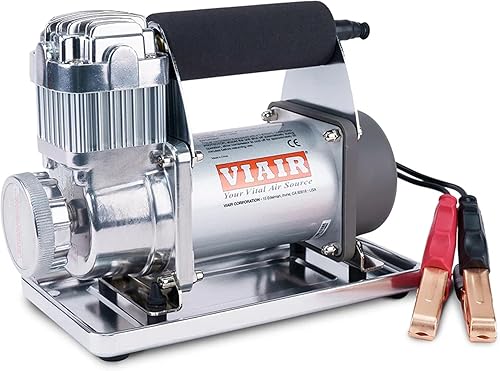
VIAIR 300P: Best for truck and SUV owners
- 2.3 CFM free-flow capacity
- 150 PSI maximum working pressure
- For tires up to 33 in
- 25 ft air hose
The 300P pairs 2.3 CFM airflow with a 150 PSI maximum working pressure for truck and SUV tires up to 33 in. It includes a 25 ft hose and carry bag.
Pros
- 2.3 CFM free-flow capacity
- 25 ft hose
- Carry bag included
Cons
- Engine needs to run during use
- 33% duty cycle
The VIAIR 300P suits trucks, SUVs and Jeeps with tires up to 33 in. Its free-flow capacity is 2.3 CFM, and maximum working pressure is 150 PSI.
The 25 ft hose reaches around a vehicle, and the kit includes a carry bag and inline gauge. It connects to a vehicle battery with clamps; the engine needs to be running during use.
The 33% duty cycle means it is not meant to run without limits. Follow the manual's run and rest guidance, especially when you have several tires to inflate.
Choose the 300P for a compact truck-tire kit with a useful hose length and clear size guidance. If your tires approach 35 in, compare the 400P.
VIAIR 400P: Best for larger off-road tires
- 2.3 CFM free-flow capacity
- 150 PSI maximum working pressure
- For tires up to 35 in
- 25 ft air hose
The 400P has the same stated airflow and maximum pressure as the 300P, with a recommended maximum tire size of 35 in. Its kit includes a 25 ft hose and carry bag.
Pros
- Recommended for tires up to 35 in
- 25 ft hose
- Includes inflation adapters
Cons
- 33% duty cycle at 100 PSI
- 10.4 lb compressor
The VIAIR 400P is the better fit when you need a compressor specified for tires up to 35 in. It shares the 300P's stated airflow and maximum working pressure, so the main distinction is the larger recommended tire-size limit.
Its kit includes a 25 ft hose, battery clamps, carry case, inflation tips and a Presta valve adapter. The compressor weighs 10.4 lb, and its duty cycle is 33% at 100 PSI.
This pick makes sense for larger off-road tires and vehicle-side use. Skip it if your priority is a particularly light kit or a cigarette-lighter connection; the 88P is lighter, while the AIR10 plugs into a 12V auxiliary socket.
VIAIR 88P: Best for lightweight vehicle kits
- 1.47 CFM free-flow capacity
- 120 PSI maximum working pressure
- For tires up to 33 in
- 16 ft air hose
The 88P is a smaller battery-clamp option for tires up to 33 in. It includes a built-in gauge, LED work light, 16 ft hose and carry bag.
Pros
- 4.75 lb stated weight
- Built-in pressure gauge
- LED work light
Cons
- Lower airflow than the VIAIR 300P and 400P
- 25-minute duty cycle at 30 PSI
The VIAIR 88P is a compact battery-clamp option for cars, trucks and SUVs with tires up to 33 in. At about 4.75 lb, it is easier to store and carry than the heavier dual-cylinder models.
It has a built-in pressure gauge, LED work light, carry bag and 16 ft air hose. Its airflow and maximum working pressure are lower than the 300P and 400P, and the stated duty cycle is 25 minutes at 30 PSI.
Choose the 88P for a lighter vehicle kit that can also handle compatible bikes, balls and inflatables with the included tips. Skip it if you need the higher airflow of the 300P or 400P for repeated work on larger tires.
NOCO AIR20: Best for digital pressure presets
- 47 L/min airflow
- 100 PSI maximum pressure
- For tires up to 35 in
- Auto shutoff and dwell technology
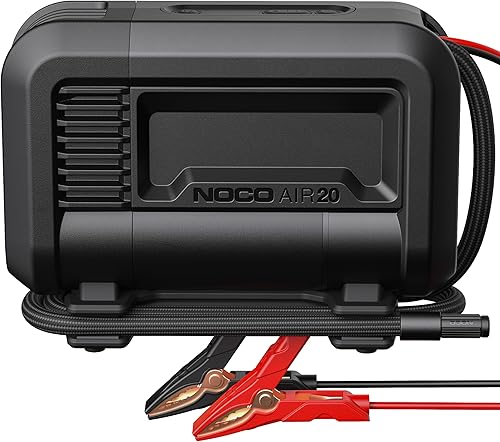
The AIR20 combines a digital pressure display with automatic shutoff and pause-and-resume control. It supports tire sizes up to 35 in and includes a 20 ft power cord.
Pros
- Pressure settings from 15 to 100 PSI
- Automatic shutoff
- 20 ft power cord
Cons
- Manual mode is needed below 15 PSI
- 3 ft inflation hose
The NOCO AIR20 suits drivers who want a digital target pressure and automatic control. Set a pressure from 15 to 100 PSI; the unit pauses and resumes near the target, then shuts off.
Its 47 L/min airflow and stated tire limit of 35 in make it a fit for many vehicles. NOCO gives an inflation time of 2.5 minutes from 0 to 40 PSI for a 205/65R16 tire, so use that as a reference for that tire and range, not a promise for every tire.
The AIR20 connects to the battery with clamps and has a 20 ft power cord, but its inflation hose is only 3 ft long. Choose it for preset control and larger tire compatibility; skip it if a long hose or a 12V socket connection matters more.
NOCO AIR10: Best for socket-powered inflating

- 36 L/min airflow
- 60 PSI maximum pressure
- For tires up to 31 in
- Digital display and auto shutoff
The AIR10 plugs into a 12V auxiliary port and adds a digital display with automatic shutoff. Its stated tire-size limit is 31 in, with pressure settings from 15 to 60 PSI.
Pros
- Uses a 12V cigarette lighter plug
- Automatic shutoff
- 10 ft power cord
Cons
- 60 PSI maximum pressure
- Manual mode is needed below 15 PSI
The NOCO AIR10 is the pick for drivers who want a socket-powered inflator with digital controls. Its 10 ft power cord plugs into a 12V auxiliary port, and the display accepts pressure settings from 15 to 60 PSI.
Its stated tire limit is 31 in, with a 60 PSI maximum. NOCO gives a 3.8-minute inflation time from 0 to 40 PSI for a 205/65R16 tire.
The AIR10 also pauses and resumes near the target, then shuts off automatically. Its 3 ft hose calls for placing the compressor close to the tire.
Choose it when your vehicle's auxiliary port, tire size and pressure needs fit those limits; skip it for larger tires or pressure targets above 60 PSI.
ALL-TOP Dual Cylinder 12V Kit: Best for overland gear

- 350 L/min stated airflow
- 150 PSI maximum pressure
- Dual-cylinder design
- 26 ft air hose
This dual-cylinder kit states 350 L/min airflow and 150 PSI maximum pressure. It comes with a 26 ft hose, pressure gauge, adapters and storage bag.
Pros
- 26 ft air hose
- Over-current protection
- Thermal cut-off
Cons
- 24 lb compressor
- The maker cautions that an external inflator needs over-pressure protection
The ALL-TOP Dual Cylinder 12V Kit is for drivers who want a heavy-duty compressor with a long hose and a broad set of adapters. It states 350 L/min airflow and a maximum pressure of 150 PSI.
The 26 ft rubber hose has a pressure gauge, and the kit includes three nozzle adapters, a thumb-lock adapter and a storage bag. Thermal cut-off and over-current protection are included.
At 24 lb, this unit is a poor fit if you want a light emergency inflator to carry frequently. If you connect a separate gauge inflator, ALL-TOP cautions that it needs over-pressure protection.
Choose it for a long hose and off-road or recreational inflation tasks. Skip it if compact storage is a priority or you don't need a heavier dual-cylinder setup.
VEVOR 10.6 CFM Dual-Cylinder 12V: Best for reaching all four tires
- 10.6 CFM stated airflow
- 150 PSI maximum pressure
- 26 ft air hose
- Thermal cut-off protection
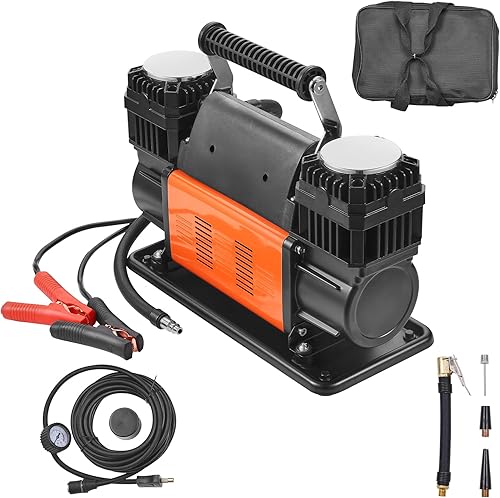
VEVOR pairs a dual-cylinder design with a 26 ft hose and 6.5 ft power cord. Its kit includes a mechanical pressure gauge, adapters and a carry bag.
Pros
- 26 ft hose
- Thermal cut-off protection
- 150 PSI maximum pressure
Cons
- 25.4 lb compressor
- 75 A maximum current
The VEVOR dual-cylinder compressor fits drivers who want a long hose and high stated airflow. It has a 26 ft air hose, a 6.5 ft power cord, a mechanical gauge and three adapters.
VEVOR states 10.6 CFM airflow and 150 PSI maximum pressure, with thermal cut-off protection. Its maximum current is 75 A, so check your vehicle and power setup against the compressor instructions before use.
At 25.4 lb, it takes more storage space and effort to move than the compact models. Choose it for vehicle-side reach and a dual-cylinder design; skip it if you want a lightweight kit or a simple socket plug.
Kohree Four-Cylinder 12V: Best for off-road presets

- 400 L/min stated airflow
- 150 PSI maximum pressure
- Four-cylinder design
- Auto shutoff
The Kohree uses a four-cylinder design and a digital panel for preset pressure with automatic shutoff. Its kit includes a 26 ft hose, adapters and a storage bag.
Pros
- Digital pressure settings in three units
- Auto shutoff
- Thermal cut-off protection
Cons
- The compressor heats up during use
- Turn it off before reading pressure
The Kohree Four-Cylinder 12V is the standout for drivers who want a digital preset panel in a heavy-duty kit. It supports PSI, bar and kg/cm², then shuts off automatically at the selected pressure.
The four-cylinder design has stated airflow of 400 L/min and maximum pressure of 150 PSI. The package includes a 26 ft hose, a 5.9 ft power cord, adapters and a storage bag.
Kohree advises turning the compressor off before reading pressure. It may pause briefly during inflation to stabilize airflow and readings, and the unit heats during use, so avoid touching it while it runs.
Choose this model for preset control and a long hose in an off-road kit. Skip it if you want a light compressor for a small car or don't need its larger format.
How do you choose the right 12V air compressor?
Start with tire size and power connection, then decide how much hose reach and control you need. This order rules out models that cannot suit your vehicle before you compare convenience features.
For many passenger cars and smaller SUVs, the VIAIR 88P or NOCO AIR10 may fit if their stated tire limits and power connections match your setup. For larger truck tires, consider the VIAIR 300P, 400P or NOCO AIR20, which have stated limits up to 33 or 35 in.
Next, consider the number of tires and how often you'll inflate them. Duty cycle describes how much operating time a compressor can handle before it needs to rest, so a model with a limited duty cycle may not suit repeated inflation sessions.
Finally, choose how you'll read pressure. A built-in gauge keeps the kit simple, while digital preset controls can reduce guesswork during inflation.
A separate gauge is useful for checking pressure after the compressor stops.
Does a higher PSI rating mean faster inflation?
No. Maximum PSI tells you the compressor's pressure ceiling, not how quickly it fills a tire.
Inflation speed also depends on airflow, tire size, starting pressure and duty cycle. The VIAIR 300P and 400P both state 2.3 CFM and 150 PSI maximum working pressure; NOCO's fill times for the AIR20 and AIR10 refer to a particular tire size and pressure range.
For more context, read how long it takes to inflate a tire. Keep the compressor's pressure ceiling separate from the tire pressure recommended by your vehicle maker.
Should you choose battery clamps or a 12V socket?
Choose the connection that your vehicle supports and that fits the compressor's requirements. The NOCO AIR10 plugs into a 12V auxiliary port; the VIAIR 300P, 400P and NOCO AIR20 use battery clamps.
A socket plug can make setup straightforward, but the unit must stay within the limits of the outlet. Battery-clamp models connect directly to the battery, so you need safe access and enough room to position the compressor and cables.
Before starting, park safely, apply the parking brake and keep leads and hoses away from moving parts, hot surfaces and traffic. Follow the compressor instructions for engine use, ventilation and rest periods; for the VIAIR 300P, the engine needs to run.
How do you set up and use a 12V tire compressor?
Park on a level, safe surface and check the correct cold pressure in the vehicle manual or tire placard. Then place the compressor where its power cord and hose can reach the tire without crossing a traffic path or touching hot or moving parts.
Connect the power source as directed for your model, attach the chuck securely to the valve, and set a target if the compressor has preset controls. Stay nearby while it runs, and stop at the vehicle's recommended pressure rather than the compressor's maximum rating.
When the compressor requires it, turn it off before checking the final pressure. The VIAIR 300P gauge and Kohree instructions call for pressure checks with the compressor off; use a separate tire gauge if you want an independent reading.
For a full walkthrough, see how to fill tires with an air compressor. Check all tires when they are cold for the most useful comparison.
What common 12V compressor mistakes should you avoid?
The most common mistakes are choosing by maximum PSI alone, ignoring the power connection and running the compressor beyond its duty cycle. Each can lead to a poor fit or an interrupted inflation session.
Don't assume a socket-powered compressor will suit every outlet, or that battery clamps make every vehicle connection safe. Read your vehicle and compressor instructions, and keep the engine running only when the model's directions call for it.
Don't treat a tire's sidewall maximum as its recommended pressure. Use the vehicle placard, secure the chuck to limit air loss and recheck pressure after inflation.
If you use an external inflator with the ALL-TOP kit, heed the warning about over-pressure protection.
How do you care for a 12V air compressor?
Let the compressor cool as directed, keep its body and accessories clean, and store the hose and power leads without sharp bends. For the Kohree, the care guidance calls for regular body and filter cleaning.
Keep adapters and gauge parts together in the carry bag so they're available when needed. Before a trip, check that the clamps, plug, hose, chuck and chosen adapters are present and appear ready to use.
Which 12V air compressor should you choose?
Choose the VIAIR 300P for a versatile battery-clamp kit for tires up to 33 in, or the VIAIR 400P if you need the stated 35 in tire-size recommendation. Pick the NOCO AIR20 for digital presets, the AIR10 for a 12V socket, or a dual-cylinder model when you value high stated airflow and a long hose.
If you want a wider comparison of vehicle inflators, explore our tire inflator guide. For another option that runs without a cord during use, see our guide to cordless air compressors for car tires.
Our top 3 picks at a glance
-
1
-
2
-
3
Frequently asked questions
What is the best 12V air compressor for truck tires?
The VIAIR 300P is a strong fit for many truck tires up to 33 in, with 2.3 CFM airflow and a 150 PSI maximum working pressure. For tires up to 35 in, consider the VIAIR 400P or NOCO AIR20.
Check your tire size and the compressor's stated limits before choosing.
Can a 12V air compressor run from a car's power socket?
Some can, but check the connection and power limits. The NOCO AIR10 uses a 12V auxiliary socket, while the VIAIR 300P, VIAIR 400P and NOCO AIR20 connect to the battery with clamps.
Use the vehicle connection specified for your compressor.
Do 12V tire compressors need the engine running?
The VIAIR 300P instructions specify that the engine needs to run during use, and the VIAIR 400P instructions say to start the engine before inflation. Follow the instructions for your model and vehicle.
Keep the compressor's power leads and hose clear of moving parts.
How much airflow do you need for truck tires?
A higher stated airflow can suit larger tires or repeated inflation, but airflow figures alone don't tell you how long a tire will take to fill. The tire's size, starting pressure and compressor duty cycle also matter.
Compare the model's tire-size guidance and duty-cycle details with your use.
How do you choose between battery clamps and a 12V socket?
Choose a socket-powered unit if its pressure range, tire-size limit and connection suit your vehicle. Battery-clamp models connect directly to the battery and may have higher stated airflow or pressure, as with the VIAIR 300P and NOCO AIR20.
Check your vehicle manual and the compressor instructions before use.


